Policy Watch
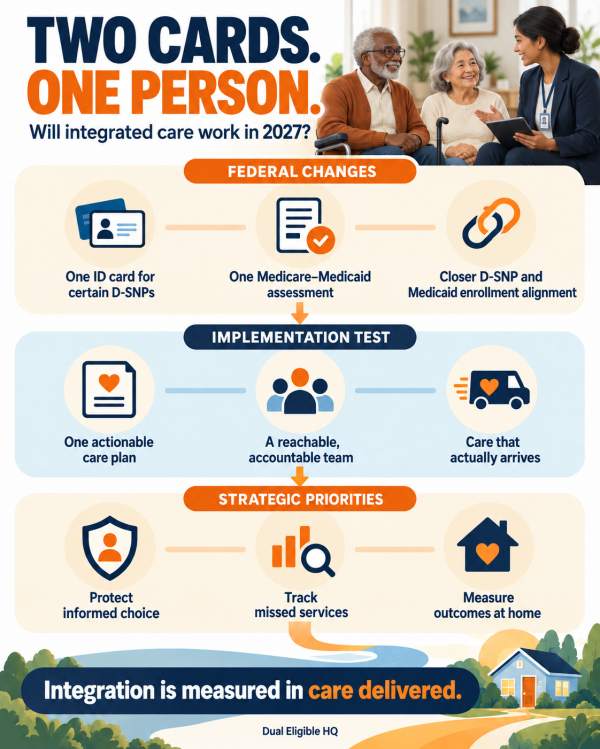
In 2027, certain dual eligible special needs plans will take another step toward aligning Medicare and Medicaid. For affected plans, a single member ID card and one integrated health risk assessment will replace separate versions. Other rules will more closely align enrollment between a D-SNP and its affiliated Medicaid managed care plan. These changes can simplify a confusing system. They cannot, on their own, ensure that a person gets the care promised by either program. [1, 2]
That is the question I would put at the center of the next phase of integration: when a person needs a physician visit, a home care worker, behavioral health treatment, or equipment, does one accountable team help make it happen? An integrated card is useful. An integrated response is the goal.
Opening Context
Medicare generally pays for hospital, physician, post-acute, and prescription drug services. Medicaid may pay Medicare premiums and cost sharing and, for full-benefit beneficiaries, long-term services and supports and other state-covered benefits. A person can qualify for both programs while dealing with separate benefit rules, provider networks, care coordinators, and appeals. Full-benefit and partial-benefit dual eligibles have different Medicaid coverage; a plan choice that fits one group may not fit the other. [3]
D-SNPs are Medicare Advantage plans for people with both programs, but the label does not tell the whole story. Some plans coordinate with Medicaid; others have greater clinical and financial responsibility for Medicaid benefits. MedPAC found that 46 percent of dually eligible beneficiaries in its July 2024 analysis were in D-SNPs, while 33 percent had traditional Medicare. The degree of integration within D-SNP enrollment varied widely. [3]
Federal Developments and What They Mean
CMS finalized the integrated card and assessment requirements for certain D-SNPs beginning in 2027. It also set timeframes for special needs plans to complete assessments and individualized care plans, with priority for involving the enrollee or representative. Separately, 2027 enrollment rules limit certain D-SNP enrollment to people in affiliated Medicaid managed care plans and limit how many D-SNP products an insurer can offer in the same area, subject to the rule’s conditions and exceptions. These policies do not mean every dual eligible person will have one plan or one card. [1, 2]
Since 2025, an integrated care special enrollment period has permitted eligible full-benefit beneficiaries to elect an integrated D-SNP in any month to align with an affiliated Medicaid plan. That creates an opportunity to correct misalignment, but counselors still need to check the individual’s providers, prescriptions, Medicaid services, and local plan options. People retain different lawful Medicare coverage choices, including traditional Medicare; integration cannot become a presumption that one option fits everyone. [2, 4]
Evidence about results remains incomplete. In its March 2026 report, MedPAC cautioned that available HEDIS and beneficiary-experience measures provide limited insight into comparative D-SNP performance; many measures are not clinical outcomes and scores are often similar across plan types. More alignment may create the conditions for better care, but it is not proof that access, health, or independence improved. [3]
What Specific Plans Show
Pennsylvania offers a familiar example. UPMC for Life Complete Care is a Medicare HMO D-SNP, while UPMC Community HealthChoices is the related Medicaid managed care option for eligible adults, including those needing long-term services and supports. A person enrolled in both has affiliated Medicare and Medicaid organizations, creating an opportunity to coordinate clinical care with personal assistance. That affiliation does not by itself establish that every beneficiary has one effective care team or that every visit is delivered. A person can also choose different Medicare coverage while enrolled in CHC. [6, 7]
New York shows why the words “D-SNP” alone are insufficient. VNS Health EasyCare Plus is a Medicare D-SNP for people who have or qualify for Medicaid, but VNS says the plan does not cover long-term in-home care. VNS Health Total is also a D-SNP; it combines Medicare Advantage with Medicaid Managed Long Term Care through the state’s Medicaid Advantage Plus arrangement. For someone needing regular assistance with daily activities, that difference is more consequential than the two plans’ shared D-SNP label. Eligibility and service-area rules still need to be checked. [8, 9, 10]
These examples are descriptions of plan designs, not endorsements or evidence that one organization delivers better outcomes. They give beneficiaries and counselors a practical set of questions: Who pays for my home care? Are my clinicians and workers available? Does the plan cover my long-term supports? Who resolves a missed service or a conflict between programs?
Policy and Market Analysis
The risk is confusing administrative alignment with care coordination. A plan may send one assessment yet fail to incorporate the home care worker’s account of a change in function. A member may carry one card and still receive different answers about equipment, transportation, or an authorized personal assistance service. Plans may share a parent company without sharing a useful service plan or a timely escalation process. These are practical risks to test, not documented outcomes for every plan.
State Medicaid agencies have a strong role in defining what D-SNP contracts require. An aligned arrangement can help when one named team sees Medicare and Medicaid needs together, understands which program pays, and has authority to resolve a service gap. It will fall short when the burden of reconciling two systems remains with the beneficiary or family. [2, 5]
There is also a measurement problem. Hospital use alone is too narrow. A successful plan would prevent missed personal assistance visits, respond to a change in behavioral health or function, complete a safe discharge, and preserve the person’s own goals. MedPAC’s finding on current quality data makes beneficiary experience and cross-program service measures especially important. [3]
Operational Implications for Plans and Providers
Plans can start by making the integrated assessment a working record, not a completed form. It needs the person’s priorities, functional supports, medication and clinical needs, caregiver availability, and an actionable backup plan. The beneficiary and the people delivering care need a way to update it when conditions change.
Medicare clinicians, Medicaid service coordinators, behavioral health providers, and home care agencies need a clear route to the same accountable contact. When a provider reports an unfilled shift or a discharge scheduled without home supports, someone must own the resolution and document whether the service occurred. Integrated appeals and grievances have value only if the person can identify the responsible plan and obtain a timely answer. [4]
Strategic Priorities
First, assess integration from the beneficiary’s perspective: one understandable explanation of benefits, a reachable coordinator, and a process that resolves conflicting instructions. Second, verify that assessments lead to care plans with named responsibilities and dates, including Medicaid long-term supports. Third, track completed services and the person’s experience across programs, not merely enrollment in an integrated product. Fourth, protect informed choice with independent counseling on traditional Medicare, D-SNP, Medicaid, and provider-network implications.
Data Point
In MedPAC’s July 2024 enrollment analysis, 46 percent of dually eligible beneficiaries were in D-SNPs, but only 3 percent were in fully integrated D-SNPs. The figures describe that period’s enrollment, not the effect of the 2027 changes. [3]
From the Advocate’s Desk
I welcome a simpler card and assessment if they spare a person from telling the same story twice. But I have seen enough of the space between a benefit and a service to ask for more. If a home care shift is missed, does the Medicare team know the person is at risk? If a hospital sends someone home, does the Medicaid team know whether support will actually arrive?
The test of integration belongs at the kitchen table, not in a plan’s organizational chart. We will know it is working when the person understands the choices, can reach someone with authority to help, and receives the medical care and daily support needed to remain well and independent. Until we measure those results, the promise of one system remains unfinished.
Sources and validation
- CMS, Contract Year 2026 MA and Part D Final Rule, April 4, 2025
https://www.cms.gov/newsroom/fact-sheets/contract-year-2026-policy-and-technical-changes-medicare-advantage-program-medicare-prescription-final - CMS, D-SNP Integration and Unified Appeals and Grievance Requirements, current guidance
https://www.cms.gov/medicare/medicaid-coordination/about/dsnps - MedPAC, March 2026 Report to Congress, Chapter 15, Mandated Report on D-SNPs
https://www.medpac.gov/wp-content/uploads/2026/03/Mar26_Ch15_MedPAC_Report_To_Congress_SEC.pdf - CMS, New Special Enrollment Periods for Dually Eligible and LIS Individuals
https://www.cms.gov/files/document/duals-lissepsjobaid01012025.pdf - MACPAC, Integrated Care for Dually Eligible Beneficiaries
https://www.macpac.gov/subtopic/integrated-care-for-dually-eligible-beneficiaries/ - UPMC Health Plan, UPMC for Life Complete Care D-SNP
https://www.upmchealthplan.com/snp - Pennsylvania DHS, Community HealthChoices Program and Managed Care Options
https://www.pa.gov/agencies/dhs/resources/medicaid/chc - VNS Health, EasyCare Plus 2026 Benefits and Long Term Home Care Exclusion
https://www.vnshealthplans.org/our-plans/vns-health-easycare-plus/benefits/ - VNS Health, VNS Health Total Medicare and Medicaid Managed Long Term Care
https://www.vnshealthplans.org/our-plans/vns-health-total/ - New York State DOH, Managed Long Term Care Plan Directory
https://www.health.ny.gov/health_care/managed_care/mltc/mltcplans