Policy Watch
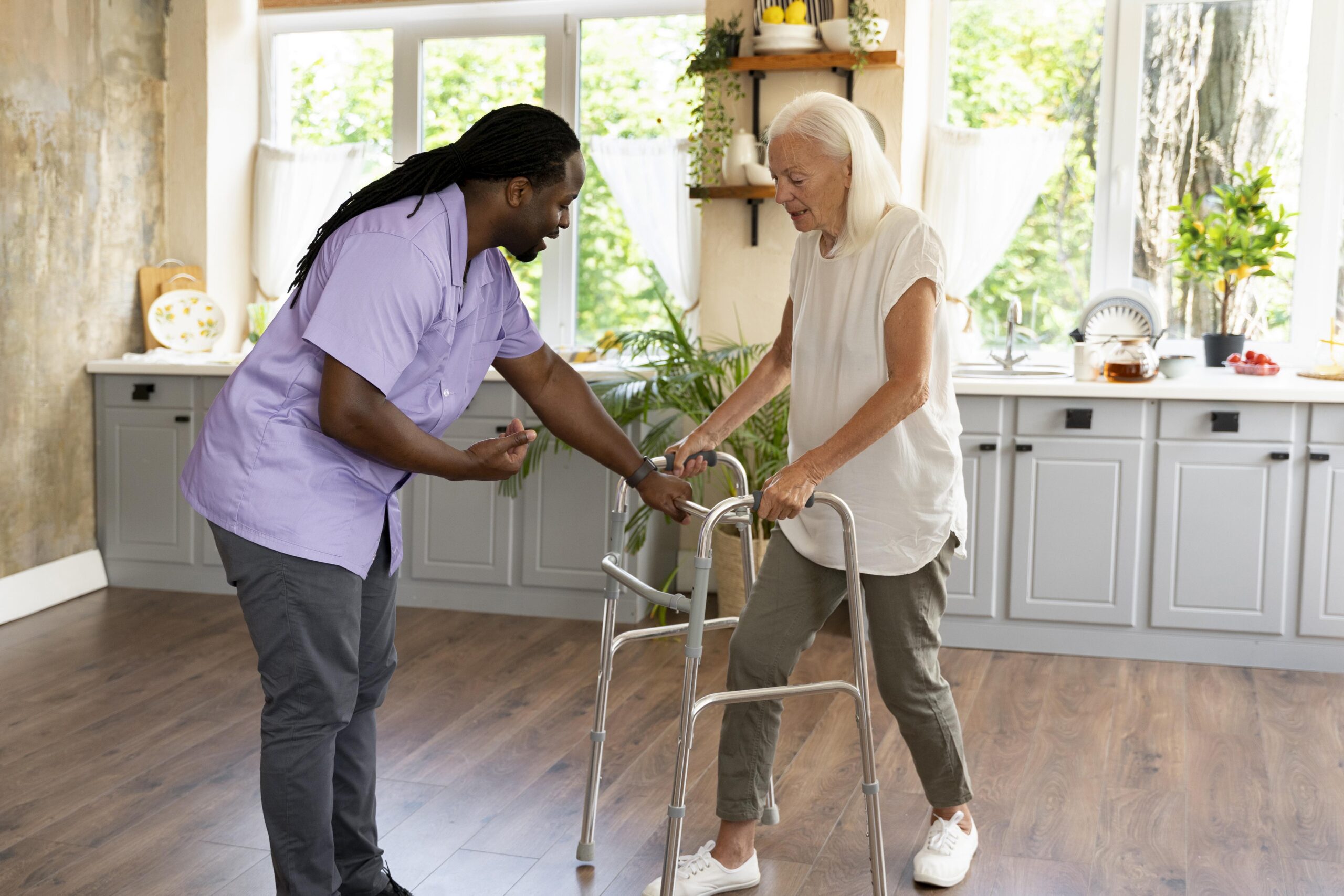
For a person who needs help to get out of bed, take medication, or manage a chronic illness, home is more than a care setting. It is where independence is lived each day. Many people enrolled in both Medicare and Medicaid depend on a combination of medical care and personal assistance to remain there. A connected device may detect a problem sooner, a video visit may bring a clinician into the home, and an electronic visit record may reveal that a caregiver never arrived. Each matters only if someone responds and the person gets the care they need. Technology can improve that response, but it cannot be the response by itself.
KFF reports that more than half of Medicaid home-care users are also enrolled in Medicare. Their medical care and long-term supports often pass through different organizations. People at home feel the gap when a clinician doesn’t know a visit was missed, or when a home-care worker sees worsening symptoms but has no way to reach the medical team. Technology adds value when it closes that time gap. [1, 2]
Opening Context
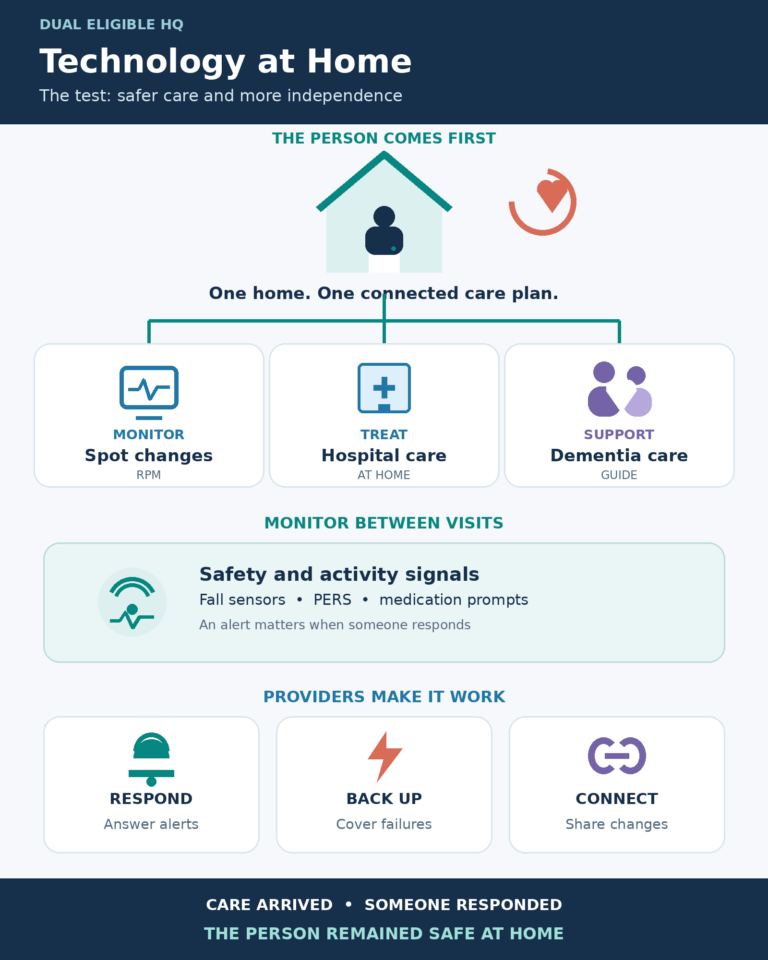
National examples vary: monitoring a health condition, delivering hospital-level care at home, coordinating dementia care, and verifying in-home visits. Each can solve a real problem for a person or family. Each can also create another alert, device, or administrative task without improving care. The test is whether the person feels safer, retains needed hands-on support, and knows whom to call when something goes wrong.
Home Health Care News has described providers’ growing use of monitoring and caregiver-facing tools, along with the importance of testing whether a tool fits real work in the home. For a consumer, that means asking simple questions before adoption: Is it accessible? Does it respect privacy? Who is watching for an alert? Can the person still reach a human being? Provider experience can identify useful tools, while independent evaluation must establish whether health and spending actually improve. [3, 4]
Where Technology Is Being Applied
Consider someone with heart failure whose weight rises over several days. A connected scale can transmit the reading, but it helps when a nurse calls, reviews symptoms, and arranges treatment before the person needs emergency care. A 2025 analysis of randomized trials found fewer heart-failure hospitalizations and deaths in remote-monitoring programs, particularly those that included education and self-management support. An earlier randomized trial found no improvement in total cost, hospitalization, symptoms, or mortality. These mixed results suggest evaluating the entire care response, not the device alone. [5, 6]
For selected patients, CMS’s Acute Hospital Care at Home initiative brings inpatient-level care into the home through in-person staff and virtual contact. The appeal is clear: treatment in familiar surroundings without losing access to hospital-level attention. CMS found generally lower 30-day mortality among home-treated patients and lower post-discharge Medicare spending for more than half of the common diagnostic groups it studied. It also warned that differences between patients prevent a firm conclusion about overall savings. The model requires careful selection, reliable staffing, and a clear route back to hospital care when the home is no longer safe. [7]
For a person with dementia, the hardest moment may arrive outside office hours, when a family caregiver is exhausted or behavior changes suddenly. CMS’s GUIDE model offers care navigation, a 24-hour support line, caregiver education, and eligible respite. The goal is to help people remain at home safely and reduce avoidable hospital or nursing-home use; savings are not yet an established result of this model. A dual eligible family needs the Medicare dementia team and Medicaid home-care team to share information and respond together, rather than asking the caregiver to connect the systems alone. [8]
Compliance and Fraud Waste and Abuse
Electronic visit verification, or EVV, can answer an immediate consumer question: Did the authorized caregiver visit take place? Federal law requires states to use EVV for qualifying Medicaid personal-care and home-health visits. Records can help identify a missed visit or questionable bill. They cannot show whether the worker provided good care, whether the person’s needs changed, or why a visit was altered. A consumer needs a prompt way to report a missed visit and obtain backup help; a program needs to reconcile the record with claims and investigate discrepancies fairly. [9]
The limits are concrete. A 2026 HHS Office of Inspector General audit found that Colorado did not verify that all sampled personal-care visits were recorded and verified in EVV and identified noncompliant claims. OIG called for stronger system edits and monitoring. For consumers, weak oversight can mean that a missed visit goes unnoticed or a pattern of service gaps persists. For workers and providers, inaccurate records can also produce unwarranted suspicion. The record needs human review and a route to correct errors. [10]
Remote monitoring needs similar accountability. Someone must explain what data are collected, who sees them, what triggers a call, and what happens during a power or internet outage. Programs must document alert responses and review unsupported billing. An automated flag can prompt a question; it should not decide that a consumer can manage with less help or that a worker acted improperly.
Operational Implications for Home-Based Care
The operational question begins with the person’s day. If an alert goes off at night, who calls? If a caregiver does not arrive, who supplies backup? If the person cannot use a phone or app, how will they reach help? Programs need named responders, clear time standards, and a backup plan. Home-care workers can report a change in walking, eating, mood, or daily function that a clinical device may never detect. Their observations need to reach the clinical team without making the consumer or family repeat the same story.
A lower bill in one program is not proof that the person is better off. Timely care might prevent an emergency visit, hospitalization, or nursing-home placement, while a poorly managed technology program could increase risk or shift unpaid work to family. A credible total-cost evaluation counts Medicare and Medicaid spending alongside technology, staffing, and response costs. It also asks whether the person got needed assistance, felt safe, and could continue living where they chose.
Quality measures need to capture what happens at home: falls and injuries, missed visits, response times, medication problems, avoidable admissions, caregiver strain, and the person’s own account of whether the service works. EVV and claims data can flag discrepancies, but staff must resolve them. Equipment and outreach must also be usable by people with sensory, cognitive, language, and mobility barriers.
Strategic Priorities for Dual Eligible Care
First, select technology to solve a problem the person recognizes. A heart-failure monitor needs a responsive clinical team; visit verification needs a way to resolve missed care. Before expansion, states and plans can test accessibility, privacy, staffing, connectivity, and backup procedures with the people who will use the service.
Second, measure the result across both Medicare and Medicaid. Track total spending, emergency and hospital use, missed visits, safety incidents, caregiver strain, and participant experience. Compare results with a suitable group so a claimed improvement reflects the program rather than a change in the people enrolled.
Third, give beneficiaries, family caregivers, and direct-care workers a real role in choosing and evaluating tools. A person can explain when monitoring offers reassurance and when it feels intrusive. A worker can describe what the data miss. Both perspectives can expose a safety problem before it becomes a hospitalization or loss of independence.
From the Advocate’s Desk
I see promise in technology that helps a person receive care sooner and remain safely at home. I also see the danger of calling every device an innovation before we know who answers its alerts. National studies show benefits in some monitoring programs and no total-cost improvement in others. CMS’s home-hospital study offers encouraging quality findings with limits on its spending conclusions. EVV can reveal missed or questionable visits, yet an OIG audit shows that oversight can fail even when the technology is installed.
For dual eligible people, the goal is straightforward: when something changes at home, the right person knows and acts. Medicare and Medicaid cannot leave the beneficiary or family caregiver to bridge the gap between their systems. A home-care worker’s observation, a clinician’s response, and a reliable service record can form one picture of the person’s needs. I would judge technology by that picture—whether care arrived, harm was prevented, and the person retained choice and dignity at home. Savings matter, but they count only when those outcomes hold.
References
- KFF. Medicaid Home Care (HCBS) in 2025. https://www.kff.org/medicaid/medicaid-home-care-hcbs-in-2025/
- KFF. State Profiles for Dual-Eligible Individuals, U.S. coverage arrangements. https://www.kff.org/interactive/state-profiles-for-dual-eligible-individuals/united-states/medicare-and-medicaid-coverage-arrangements-for-dual-eligible-individuals/
- Home Health Care News. How 3 Top Trends Have Shaped Home-Based Care This Year. Aug. 2025. https://homehealthcarenews.com/2025/08/how-3-top-trends-have-shaped-home-based-care-this-year/
- Home Health Care News. Rigorous Tech Vetting Shields Home Care Agencies From Costly Liabilities, Mismatches. Sept. 18, 2026. https://homehealthcarenews.com/2026/09/rigorous-tech-vetting-shields-home-care-agencies-from-costly-liabilities-mismatches/
- De Lathauwer et al. Remote Patient Monitoring in Heart Failure: A Comprehensive Meta-analysis. 2025. https://pmc.ncbi.nlm.nih.gov/articles/PMC12502459/
- Blum et al. Randomized Trial of Home Telemonitoring in Heart Failure. 2014. https://pubmed.ncbi.nlm.nih.gov/24769270/
- CMS. Study of the Acute Hospital Care at Home Initiative. Sept. 2024. https://www.cms.gov/newsroom/fact-sheets/fact-sheet-report-study-acute-hospital-care-home-initiative
- CMS. GUIDE Model. https://www.cms.gov/priorities/innovation/innovation-models/guide
- Medicaid.gov. Electronic Visit Verification. https://www.medicaid.gov/medicaid/home-community-based-services/home-community-based-services-guidance-additional-resources/electronic-visit-verification
- HHS OIG. Colorado Could Improve Its Electronic Visit Verification System. July 2026. https://oig.hhs.gov/reports/all/2026/colorado-could-improve-its-electronic-visit-verification-system-and-claimed-federal-medicaid-reimbursement-for-millions-of-dollars-in-personal-care-services-that-did-not-comply-with-federal-and-state-requirements/