Policy Watch
Beginning January 1, 2027, states generally must condition Medicaid eligibility for certain adults on meeting new community engagement requirements. The policy is commonly described as a Medicaid work requirement, but its implications extend well beyond employment.
Most people already enrolled in Medicare are excluded from the requirement. That may create the impression that dual-eligible beneficiaries are largely protected. The more difficult issue involves people approaching dual eligibility who have not yet become entitled to or enrolled in Medicare.
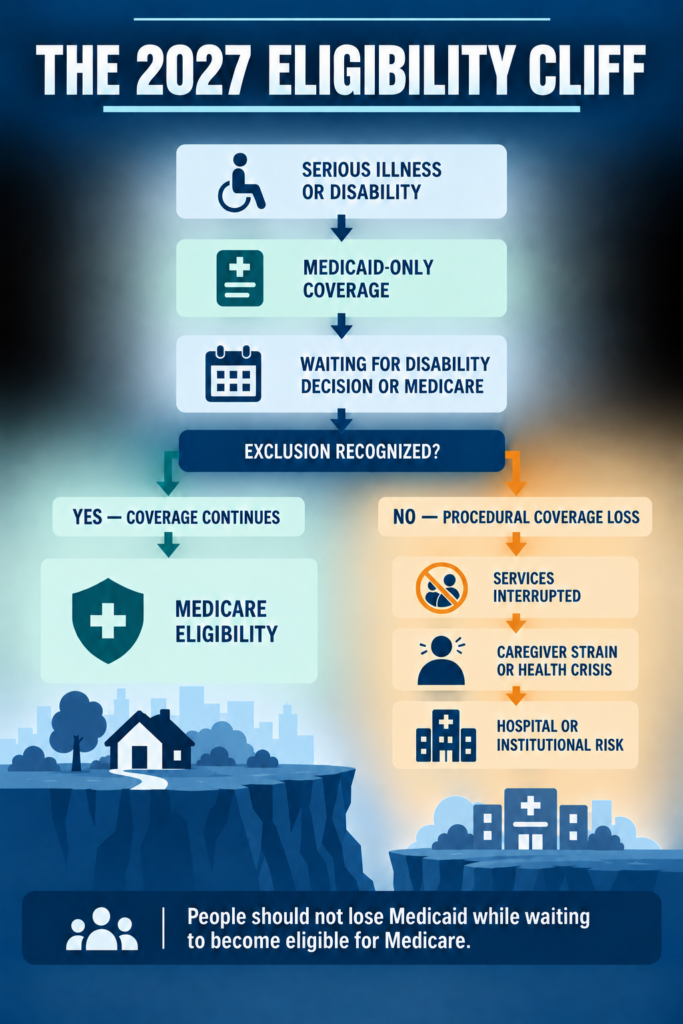
These individuals may have serious chronic illnesses, emerging disabilities, behavioral health conditions, substance use disorders, or functional limitations. They may depend on Medicaid while waiting for a disability determination or the Medicare waiting period to end. Until Medicare begins, some may remain subject to the new requirements unless the state identifies them as medically frail, disabled, otherwise excluded, or meeting the requirement through qualifying activity.
The danger is not limited to people who refuse to comply. It includes people whose health conditions make compliance difficult, whose exemption is not identified, or whose coverage is terminated because available government data do not accurately reflect their circumstances.
Opening Context
Dual eligibility is often discussed as a fixed status: a person has both Medicare and Medicaid or does not. In reality, many people experience a transition period before becoming dual eligible.
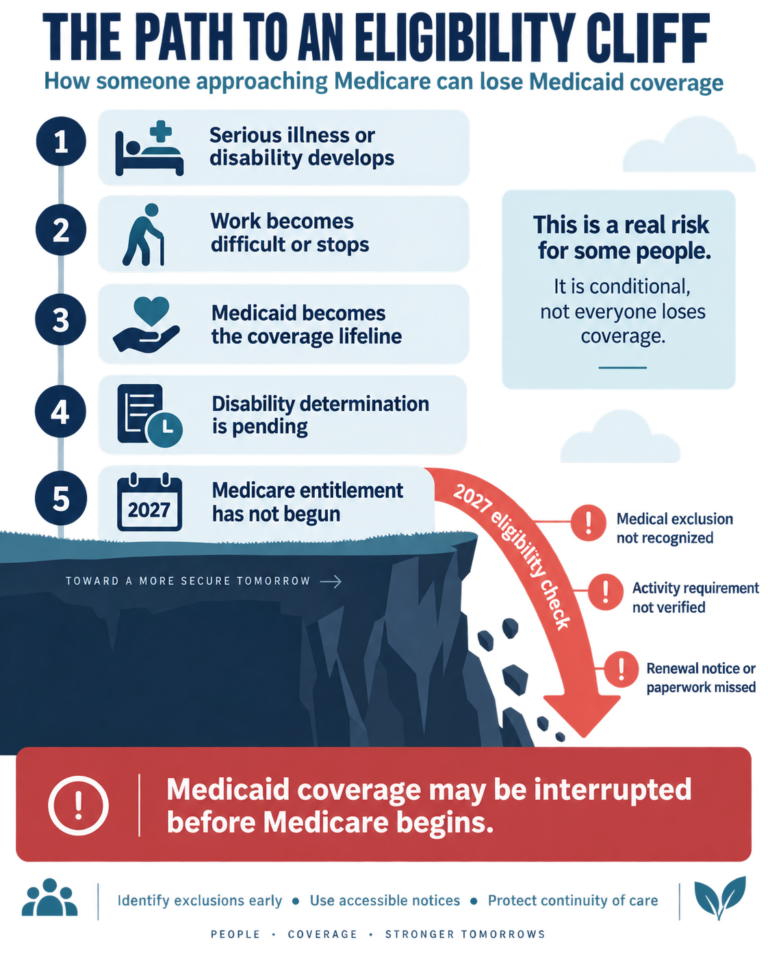
A low-income adult may develop a serious illness or disability, lose employment, enroll in Medicaid, apply for Social Security Disability Insurance, and wait for Medicare entitlement. During this period, Medicaid may be the person’s only source of comprehensive health coverage. It can support medications, physician care, behavioral health treatment, hospital services, transportation, and other services needed to prevent further deterioration.
(insert graphic 1 here or around the second paragraph)
Under the 2025 reconciliation law, Public Law 119-21, certain adults ages 19 through 64 must demonstrate at least 80 hours per month of employment, community service, participation in a qualifying work program, or a combination of qualifying activities. Enrollment in an educational program at least half-time and meeting an income-based standard can also satisfy the requirement.
The policy applies to adults in the Affordable Care Act Medicaid expansion group and certain Section 1115 demonstration populations who are not entitled to or enrolled in Medicare. KFF reports that the requirements will affect relevant populations in 44 states, including the District of Columbia. States must make major policy decisions, modify eligibility systems, establish verification processes, train staff, and conduct outreach within a relatively short implementation period. [1]
Federal Developments and What They Mean for Future Dual Eligibles
CMS issued its interim final rule on June 1, 2026. The rule confirms that adults enrolled in Medicare are outside the applicable population. It also recognizes exclusions for certain parents and caregivers, pregnant and postpartum individuals, qualifying veterans, American Indians and Alaska Natives, and individuals who are medically frail or otherwise have special medical needs. [2]
Protection for people with disabilities and serious health conditions matters, but its implementation is more complicated than the statutory categories suggest.
CMS ties medical frailty to whether a physical, mental, intellectual, developmental, or behavioral health condition significantly impairs an individual’s ability to engage in the community. KFF describes this as a more restrictive interpretation than some states initially anticipated. A diagnosis alone may not resolve the question. States must develop clinical codes and other methods to identify potentially exempt individuals and determine whether their conditions significantly impair compliance. [3]
Sellers Dorsey similarly concludes that the rule limits state flexibility by establishing detailed definitions for qualifying activities and exclusions. Its analysis notes that CMS estimates approximately 15 percent of applicable individuals may be disenrolled through a combination of noncompliance and procedural disenrollment. [4]
This creates a meaningful risk for people on the path toward dual eligibility. Some may clearly satisfy a medical-frailty exclusion. Others may have substantial limitations but lack the documentation, diagnosis codes, disability determination, or functional assessment the state needs to identify them automatically.
The timing compounds the risk. Beginning in 2027, Medicaid expansion adults will generally undergo eligibility redeterminations every six months rather than annually. At each renewal, the state may need to verify eligibility, community engagement, or an applicable exclusion.
CBO estimates that 70 percent of the people losing coverage because of the new six-month renewal policy will lose it for procedural reasons, including missed paperwork, communication problems, or difficulty navigating reenrollment – not because they are substantively ineligible. CBO separately estimates that the community engagement provision will increase the number of uninsured people by 5.3 million in 2034. [5]
Policy and Market Analysis
The central policy risk is a gap between a person’s health status and the eligibility system’s ability to recognize it.
Someone may be clinically unable to sustain regular employment but not yet meet a data-driven test for medical frailty. A person with an episodic mental health condition may appear capable of complying during one month and experience a disabling crisis the next. Someone undergoing treatment for a substance use disorder may qualify for an exclusion, but only if the state’s systems identify and process that information correctly.
People awaiting federal disability determinations present a particularly important transition concern. They may be seriously ill enough to be moving toward Medicare eligibility but not yet entitled to Medicare. Unless another exclusion applies and is properly documented, the Medicare exclusion does not protect them.
The potential coverage consequences are also unusually severe. Under the statute and CMS rule, a person denied or terminated from Medicaid for failure to satisfy community engagement is generally not eligible for Marketplace premium tax credits on that basis. This means the individual may not have an affordable alternative while trying to reestablish Medicaid eligibility. [2]
The result could be an eligibility cliff at the exact point when continuous healthcare matters most. Interrupted access to medication, specialty treatment, behavioral health services, dialysis, rehabilitation, or primary care can accelerate functional decline. Coverage loss can increase emergency department use, hospitalizations, uncompensated care, and the likelihood that a manageable condition becomes a long-term disability.
The policy therefore has direct implications for the future dual-eligible population. A system intended to verify engagement could instead interrupt the care that helps people remain stable, employed, and living independently.
Operational Implications for Community-Based Services and LTSS
For community-based and LTSS providers, the immediate concern is continuity of care. A Medicaid termination can interrupt personal assistance, behavioral health treatment, transportation, medication support, and other services that help individuals remain safely at home.
Providers are often the first to recognize that someone has received a confusing notice, is awaiting a disability determination, or has a condition that may qualify for an exclusion. They can help document functional limitations, update contact information, identify potential coverage problems, and connect individuals with benefits counseling or legal assistance.
States and managed care organizations must establish clear escalation pathways so providers can report imminent coverage losses before services are disrupted. They must also monitor whether disenrollment leads to missed visits, caregiver strain, emergency department use, hospitalization, or institutional placement.
Community providers can support this work, but eligibility administration cannot simply be transferred to them without training, clear procedures, and adequate funding.
Strategic Priorities for Community-Based Care
Implementation must protect people whose health and functional needs are not yet fully reflected in Medicaid, disability, or Medicare records.
- Use claims, encounter, disability, and Medicare data to identify exclusions automatically.
- Create a clear pathway for individuals awaiting disability determinations or Medicare entitlement.
- Accept provider documentation of functional limitations and barriers to compliance.
- Notify providers and service coordinators when coverage affecting LTSS is at risk.
- Establish rapid reinstatement and appeal processes before essential services are interrupted.
- Track procedural terminations, unfilled service needs, hospitalizations, caregiver crises, and institutional placements.
- Fund CILs, aging and disability organizations, behavioral health providers, and other trusted community partners to provide outreach and navigation.
The standard for success is not simply whether the state implements the requirement on time. It is whether eligible individuals retain coverage and whether people who depend on community-based services can continue living safely and independently.
Data Point
CBO estimates that the Medicaid community engagement provision will increase the number of uninsured people by approximately 5.3 million in 2034. CMS estimates that about 15 percent of adults subject to the requirement may be disenrolled through noncompliance or procedural loss. [4, 5]
Those figures involve more than employment status. They reflect whether eligibility systems can accurately distinguish among people who can comply, people who qualify for exclusions, and people whose circumstances existing data do not capture.
For dual eligible people, the goal is straightforward: when something changes at home, the right person knows and acts. Medicare and Medicaid cannot leave the beneficiary or family caregiver to bridge the gap between their systems. A home-care worker’s observation, a clinician’s response, and a reliable service record can form one picture of the person’s needs. I would judge technology by that picture—whether care arrived, harm was prevented, and the person retained choice and dignity at home. Savings matter, but they count only when those outcomes hold.
From the Advocate’s Desk
The most misleading assumption about the 2027 requirements is that people with disabilities are automatically protected.
Some will be. Many current dual-eligible beneficiaries will be outside the requirement because they already have Medicare. Individuals whose disabilities or medical frailty are identified and verified will also qualify for protection.
The greatest risk lies between those categories.
A person can be too ill to work consistently but not yet entitled to Medicare. A person can be waiting for a disability decision while depending on Medicaid for treatment. Someone with a serious mental health condition or substance use disorder can qualify for an exclusion but still lose coverage if the state does not identify the condition or the individual cannot navigate the documentation process.
That is the 2027 eligibility cliff.
Healthcare coverage should not disappear because the eligibility system lags behind the person’s medical reality. Nor should people lose access because one government program has not yet received information another already holds.
States have limited time to get this right. The responsible approach begins with automatic data matching, accessible notices, strong community partnerships, and a presumption that procedural confusion is not the same as unwillingness to work.
Providers and plans also have a role. They see the individual behind the eligibility record. They know when medication has been interrupted, when a chronic condition is worsening, and when a person is moving toward disability and Medicare entitlement. Their information must become part of the protection system.
The transition to dual eligibility is already one of the most complicated passages in American healthcare. The new requirements must not turn that passage into a coverage gap.
Protecting current dual eligibles is important. Protecting the people who are becoming dual eligible is equally important. The integrity of an integrated Medicare-Medicaid system depends on ensuring that people can reach it without losing the care that keeps them alive, stable, and independent along the way.
References
- KFF. Tracking Implementation of the 2025 Reconciliation Law: Medicaid Work Requirements. Updated August 3, 2026.
- Centers for Medicare & Medicaid Services. Medicaid Community Engagement Requirement for Certain Individuals Interim Final Rule with Comment Period. June 1, 2026.
- KFF. The Medical Frailty Exemption from Medicaid Work Requirements: Key Takeaways from the CMS Interim Final Rule. June 23, 2026.
- Sellers Dorsey. Summary of Community Engagement Interim Final Rule. June 3, 2026.
- Congressional Budget Office. Supplemental Cost Estimate for Public Law 119-21 Medicaid Provisions. October 28, 2025.
- Health Management Associates. Medicaid Community Engagement Interim Final Rule: Key Implications for States, Payers, and Providers. June 5, 2026.
- Health Management Associates. Turning HR 1 Medicaid Work Requirements into Workforce Development Opportunities. October 7, 2025.
- Federal Register. Medicaid Program; Community Engagement Requirement for Certain Individuals. June 3, 2026.